Accessoires
Bijoux de tête : l'accessoire qui change tout
Par Alexandre Zouari · 20 mai 2026 · Lecture 3 min
Barrette, peigne, serre-tête ou fil de cristaux : le bijou de tête est la touche finale qui transforme une coiffure simple en parti pris couture. Petit guide pour l'apprivoiser, signé par celui qui en a fait une marque internationale.
Avant d'être une tendance, le bijou de tête est une histoire ancienne — celle des diadèmes, des peignes espagnols, des résilles de perles et des coiffes de mariées qui traversent les siècles et les cultures. Alexandre Zouari a su en faire un langage contemporain. Dès la fin des années 2000, il dessine des lignes de bijoux de tête qui rencontrent un succès immédiat, jusqu'à essaimer dans plus de quarante boutiques en Asie. Son intuition : ce petit objet, bien pensé et bien placé, possède un pouvoir disproportionné. Il attire la lumière exactement là où il faut, souligne une attache, prolonge un regard. Peu de matière, beaucoup d'effet — à condition de respecter quelques règles.
La signature d'une maison
Ce qui distingue un bijou de tête d'exception d'un simple accessoire, c'est le savoir-faire. Chez Alexandre Zouari, chaque pièce est dessinée par le créateur puis façonnée à la main en Europe. Les cristaux — souvent des Swarovski — sont sertis un à un par des maîtres artisans, garantissant cet éclat profond qui capte la moindre source de lumière. Deux collections voient le jour chaque année, pensées comme des collections de mode à part entière.
« Le bon accessoire ne se voit pas en premier : on voit d'abord la femme, puis on remarque le détail. »
Les grandes familles de bijoux de tête
Avant de choisir, encore faut-il connaître le vocabulaire. Chaque type de bijou raconte une histoire différente et s'accorde à une coiffure précise.
La barrette
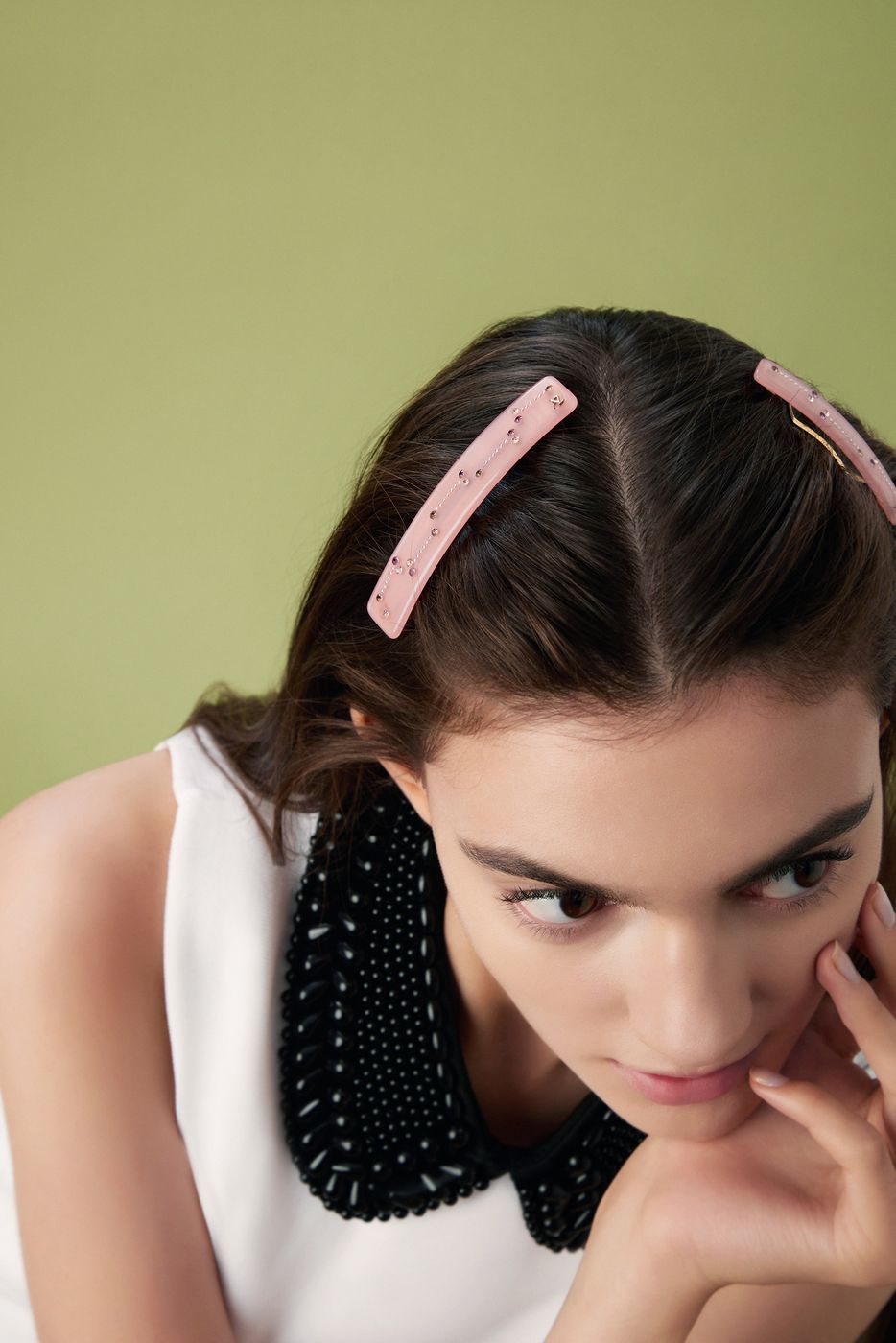
La plus polyvalente. Discrète et mate, elle retient une mèche en journée ; sertie de cristaux, elle devient le point lumineux d'une coiffure de soirée. On la porte sur le côté, en duo asymétrique, ou pour épingler une demi-attache.
Le peigne
L'allié du chignon. Glissé à la base ou sur le côté d'un attaché, il apporte une touche précieuse et structure la coiffure. C'est l'accessoire de mariée par excellence, capable de maintenir un voile.
Le serre-tête et le headband
Le plus graphique. Il dégage le visage, structure des cheveux lâchés et donne instantanément une allure soignée. Fin et orné pour le soir, plus large et sobre pour le jour.
La vigne et le fil de cristaux
Le plus romantique. Enroulé dans un chignon ou une tresse, ce bijou souple dessine des points de lumière au fil de la coiffure. Idéal pour les mariées et les coiffures bohèmes chic.
L'art de bien le porter
La première règle, et la plus importante, tient en une idée : un seul point fort. Un bijou de tête se suffit à lui-même. On choisit un point focal — une barrette latérale, un peigne à l'arrière d'un chignon — et l'on laisse le reste de la coiffure le mettre en valeur. Multiplier les ornements brouille le message ; l'élégance naît ici de la retenue.
La deuxième règle concerne l'harmonie : on accorde le métal du bijou (or, argent, or rose) à ses autres parures, boucles d'oreilles et bagues comprises. Enfin, on laisse toujours la coiffure respirer autour de l'accessoire. Le bijou souligne — il n'étouffe jamais.
Du jour au soir
La grande force du bijou de tête est sa capacité à changer de registre. Discret et mat, il accompagne une tenue de jour sans ostentation. Serti de cristaux, il transfigure la même coiffure pour une soirée. Sur cheveux lâchés, il structure et raffine ; sur chignon, il couronne. C'est sans doute l'accessoire le plus économique en apparence et le plus spectaculaire en résultat — le secret le mieux gardé des femmes élégantes.
Comment le choisir
Pour ne pas se tromper, quelques repères :
- Partez de la coiffure et de l'occasion, pas de l'objet : un peigne pour un chignon, une barrette pour une attache, un headband pour des cheveux lâchés.
- Accordez le métal à vos bijoux et le ton des cristaux à votre carnation et à votre tenue.
- Pour un mariage, testez le bijou avec la coiffure complète et le voile, jamais le jour J pour la première fois.
- Préférez une belle pièce, bien façonnée, à plusieurs accessoires bon marché : la lumière d'un cristal serti à la main ne se compare à rien.
- En cas de doute, choisissez la sobriété : c'est toujours elle qui paraît la plus chère.
Le bijou de tête est, en somme, la ponctuation d'une coiffure : un point précieux qui change le sens de toute la phrase. Bien choisi, bien placé, il signe une allure — discrètement, mais pour toujours.
Barrette, comb, headband or thread of crystals: head jewellery is the finishing touch that turns a simple hairstyle into a couture statement. A short guide to taming it, signed by the man who made it an international brand.
Before it was a trend, head jewellery was an old story — that of tiaras, Spanish combs, pearl nets and bridal headpieces that cross centuries and cultures. Alexandre Zouari knew how to make it a contemporary language. From the late 2000s, he designed lines of head jewellery that met with immediate success, spreading to more than forty boutiques across Asia. His intuition: this small object, well conceived and well placed, holds a disproportionate power. It attracts the light exactly where it should, underlines an attachment, extends a gaze. Little matter, great effect — provided a few rules are respected.
The signature of a maison
What distinguishes exceptional head jewellery from a mere accessory is craftsmanship. At Alexandre Zouari, each piece is designed by the creator then handcrafted in Europe. The crystals — often Swarovski — are set one by one by master artisans, guaranteeing that deep sparkle which catches the faintest source of light. Two collections are born each year, conceived as fully-fledged fashion collections.
« The right accessory is not seen first: you see the woman first, then you notice the detail. »
The great families of head jewellery
Before choosing, one must know the vocabulary. Each type of jewel tells a different story and suits a precise hairstyle.
The barrette
The most versatile. Discreet and matte, it holds a strand by day; set with crystals, it becomes the luminous point of an evening hairstyle. Wear it on the side, in an asymmetric pair, or to pin a half-up style.
The comb
The chignon's ally. Slipped at the base or on the side of an updo, it brings a precious touch and structures the hairstyle. It is the bridal accessory par excellence, able to hold a veil.
The headband
The most graphic. It clears the face, structures loose hair and instantly gives a polished allure. Fine and ornate for the evening, wider and understated for the day.
The vine and thread of crystals
The most romantic. Wound through a chignon or a braid, this supple jewel draws points of light along the hairstyle. Ideal for brides and boho-chic styles.
The art of wearing it well
The first rule, and the most important, comes down to one idea: a single focal point. Head jewellery is self-sufficient. Choose a focal point — a side barrette, a comb at the back of a chignon — and let the rest of the hairstyle set it off. Multiplying ornaments blurs the message; here, elegance is born of restraint.
The second rule concerns harmony: match the metal of the jewel (gold, silver, rose gold) to your other pieces, earrings and rings included. Finally, always let the hairstyle breathe around the accessory. The jewel underlines — it never smothers.
From day to night
The great strength of head jewellery is its ability to change register. Discreet and matte, it accompanies a daytime look without ostentation. Set with crystals, it transfigures the same hairstyle for an evening. On loose hair it structures and refines; on a chignon it crowns. It is surely the most modest-looking accessory and the most spectacular in result — the best-kept secret of elegant women.
How to choose it
To avoid missteps, a few landmarks:
- Start from the hairstyle and the occasion, not the object: a comb for a chignon, a barrette for an attachment, a headband for loose hair.
- Match the metal to your jewellery and the tone of the crystals to your complexion and outfit.
- For a wedding, test the jewel with the full hairstyle and veil, never for the first time on the day itself.
- Prefer one beautiful, well-crafted piece to several inexpensive accessories: the light of a hand-set crystal compares to nothing.
- When in doubt, choose sobriety: it always looks the most precious.
Head jewellery is, in short, the punctuation of a hairstyle: a precious point that changes the meaning of the whole sentence. Well chosen, well placed, it signs an allure — discreetly, but forever.
发夹、发梳、发箍或水晶发丝:头饰是那点睛之笔,将简单的发型化为高定的态度。以下小指南,由将其打造为国际品牌的人亲自署名。
在成为潮流之前,头饰早已是一段古老的故事——冠冕、西班牙发梳、珍珠发网与新娘头饰,穿越世纪与文化。亚历山大·祖阿里懂得将其化为当代语言。自 2000 年代末起,他设计的头饰系列即刻大获成功,遍布亚洲逾四十家精品店。他的直觉是:这枚小小之物,若构思与佩戴得当,便拥有不成比例的力量。它将光线引至恰当之处,凸显一处挽结,延展一道眼神。以少胜多——前提是遵循几条法则。
一个品牌的签名
令一件非凡头饰有别于普通配饰的,是工艺。在亚历山大·祖阿里,每一件都由创造者设计,随后于欧洲手工打造。水晶——多为施华洛世奇——由工艺大师逐颗镶嵌,成就那捕捉丝毫光线的深邃闪耀。每年推出两个系列,如同真正的时装系列般构思。
「好的配饰不会第一眼被看见:人们先看见女人,再注意到细节。」
头饰的主要家族
在选择之前,须先了解其语汇。每一种饰品讲述不同的故事,并与特定发型相配。
发夹
最百搭。低调而哑光,白天用以固定一缕发丝;镶以水晶,则成为晚宴造型的亮点。可佩于一侧、成对不对称,或用以别起半扎发。
发梳
发髻的盟友。插于底座或挽发一侧,带来珍贵感并强化结构。它是当之无愧的新娘配饰,能承托头纱。
发箍与头带
最具图形感。它舒展面容,为披散的头发赋予结构,瞬间带来精致气度。纤细而华丽用于夜晚,宽阔而素雅用于白天。
发藤与水晶发丝
最浪漫。缠绕于发髻或发辫之间,这柔软的饰品沿发型描绘点点光芒。是新娘与波西米亚别致造型的理想之选。
佩戴的艺术
第一条、也是最重要的法则,归于一个理念:单一焦点。头饰自成一体。选定一个焦点——侧旁发夹、发髻后的发梳——让其余发型为之衬托。堆叠饰品会模糊表达;此处优雅源于克制。
第二条法则关乎和谐:使饰品的金属色(金、银、玫瑰金)与其他珠宝(含耳环与戒指)相配。最后,始终让发型在配饰周围保留呼吸。饰品用以凸显,绝不掩盖。
从白天到夜晚
头饰的巨大魅力在于其转换气质的能力。低调哑光,它不动声色地陪伴日间造型。镶以水晶,它令同一发型为夜晚焕然一新。于披散的头发上它塑造结构,于发髻上则为其加冕。它或许是外表最朴素、效果却最惊艳的配饰——优雅女性最珍藏的秘密。
如何挑选
为免出错,几点参照:
- 从发型与场合出发,而非饰品本身:发髻配发梳,挽结配发夹,披发配发箍。
- 使金属色与你的珠宝相配,水晶色调与你的肤色及着装相配。
- 婚礼时请连同完整发型与头纱一同试戴,切勿在当天才第一次尝试。
- 宁选一件精工细作的美物,也不选多件廉价配饰:手工镶嵌水晶的光芒无可比拟。
- 拿不定主意时,选择素雅:它总是看起来最为珍贵。
总而言之,头饰是发型的标点:一个珍贵的点,改变整句话的含义。选得好、戴得对,它便为气质署名——低调,却隽永。